It’s the most common question in the alcohol marker world: should you spend $7 on a Copic Sketch or $0.50 on an Ohuhu? Is Copic really fourteen times better? Or is Ohuhu good enough that the price difference is pure brand premium?
The answer, as with most things in art, is nuanced. We’ve used both brands extensively — drawing the same subjects, on the same paper, with the same techniques — to give you an honest, detailed comparison. By the end of this article, you’ll know exactly which brand is right for your skill level, budget, and goals.
The Price Gap: By the Numbers
Let’s start with the elephant in the room. Here’s what you’re actually paying:
| Metric | Ohuhu Honolulu (Brush) | Copic Sketch |
|---|---|---|
| Price per marker | ~$0.50 (in sets) | ~$7.00 (individual) |
| 48-color set | ~$25 | ~$336 (if bought individually) |
| Cost of full range | ~$160 (320 colors) | ~$2,500 (358 colors) |
| Refill cost | N/A (not refillable) | ~$6 per bottle (9 refills) |
| Replacement nib cost | N/A (not replaceable) | ~$2 per 3-pack |
| 5-year cost (heavy use) | ~$150–$300 (replacing dried markers) | ~$100–$200 (refills + nibs) |
That last row is important. Copic’s upfront cost is enormous, but the refill system means heavy users can actually spend less over time than they would constantly replacing budget markers.
Ink Quality: Head to Head
Consistency
Copic inks are manufactured to exacting standards. The color you get in a BV04 marker purchased in Tokyo will match the BV04 purchased in New York, and it will match the BV04 refill ink you buy three years from now. This batch-to-batch consistency is critical for professional work where color matching matters.
Ohuhu’s ink consistency has improved dramatically since their early years, but there are still occasional reports of color variation between batches. We noticed a slight shift in two colors (a warm gray and a teal) when comparing markers from a 2024 purchase to a 2025 purchase. For most hobbyists, this is imperceptible. For professionals matching colors across a multi-page comic or illustration series, it could be problematic.
Winner: Copic, by a clear margin.
Blending
This is the most critical performance metric for alcohol markers, and it’s where the quality gap is most apparent.
Copic inks blend with an almost magical fluidity. Two colors placed next to each other merge at their boundary with minimal effort — a few back-and-forth strokes create a seamless gradient that looks airbrushed. The alcohol solvent in Copic’s formulation seems to have a longer working time, giving you more seconds to manipulate the ink before it sets.
Ohuhu inks blend well — considerably better than any budget marker from five years ago — but the transitions are slightly less smooth. You’ll notice more visible overlap marks in complex gradients, and the working time is shorter, meaning you need to move faster. Two-color blends are nearly as good as Copic. Three-color blends reveal the gap.
Winner: Copic, with the caveat that Ohuhu’s blending is genuinely good for the price.
Color Saturation and Vibrancy
Both brands produce vibrant colors. Copic’s inks tend to be slightly more saturated in the reds, oranges, and purples. Ohuhu’s greens and blues are surprisingly close to Copic’s. Where Copic pulls ahead is in the subtlety of light tints and pastel colors — Copic’s light values have a luminous, clean quality that Ohuhu’s lighter colors sometimes lack (they can appear slightly chalky on paper).
Winner: Copic, slightly. The difference is most noticeable in light tints.
Lightfastness
Lightfastness — how well the ink resists fading when exposed to light — matters if you’re creating work for display, sale, or exhibition.
Copic publishes lightfastness ratings for every color and offers a dedicated «super lightfast» ink series. Their standard inks have good to very good lightfastness. Ohuhu does not publish lightfastness ratings, and independent tests suggest their inks fade noticeably faster under UV exposure — some colors showing visible fading within weeks of direct sunlight exposure.
If your work stays in a sketchbook or gets scanned digitally, this is irrelevant. If you sell originals or display them on walls, it matters enormously.
Winner: Copic, decisively.
Nib Comparison
Brush Nib
The Copic Sketch’s Super Brush nib is the gold standard in alcohol markers. It’s a synthetic fiber brush that responds to pressure with calligraphic variation — light pressure gives you a fine line, heavy pressure gives you a broad stroke. It’s resilient, bouncing back to its point after thousands of strokes. It’s also replaceable, so when it eventually does wear, you swap it for a new one in seconds.
The Ohuhu Honolulu brush nib is — and this is genuinely impressive — pretty close to the Copic experience. It’s flexible, responsive, and produces good line variation. It’s slightly stiffer than the Copic, which means slightly less calligraphic range, and it wears faster under heavy use. And since Ohuhu nibs aren’t replaceable, a worn brush nib means replacing the entire marker.
Winner: Copic, for durability and replaceability. For raw brush feel, the gap is smaller than you’d expect.
Chisel Nib
Both brands include a chisel nib on the opposite end of the brush. Copic’s Medium Broad chisel is perfectly flat and lays down even swaths of color. Ohuhu’s chisel is comparable in function, though the edges are sometimes slightly less precise out of the box. Both are adequate for flat fills and broad strokes.
Winner: Tie, functionally equivalent for most users.
Refillability and Longevity
This is Copic’s strongest advantage and Ohuhu’s most significant weakness.
Copic’s Refill System
A Copic Sketch marker body can last essentially forever. The plastic barrel doesn’t degrade, the cap seal is robust, and both nibs are replaceable. When the ink runs out (after approximately 1,200 meters of line), you refill it from a Copic Various Ink bottle for about $6 — and that bottle contains enough ink for approximately 9 refills.
Let’s do the math. One Copic Sketch costs $7. One bottle of Various Ink costs $6. Over the life of the marker body:
- Initial purchase: $7
- 9 refills: $6
- 2 nib replacements: ~$2.70
- Total lifetime cost: $15.70 for approximately 12,000 meters of line
Ohuhu’s Disposable Model
An Ohuhu marker costs about $0.50. It delivers approximately 800 meters of line before drying out. Once dry, you throw it away and buy a new one.
To match the Copic’s 12,000 meters of line:
- 15 Ohuhu markers at $0.50 each = $7.50
So in pure per-meter cost, Ohuhu is actually cheaper — about half the cost per meter of line. But this calculation ignores one thing: you can’t buy single Ohuhu markers in most stores. You typically buy sets. Replacing individual colors that run out means buying another set or hoping Ohuhu sells that specific color individually (availability is inconsistent).
Winner: Depends on your usage pattern. Copic wins for heavy users who burn through specific colors frequently. Ohuhu wins for light to moderate users who rarely deplete individual markers.
Color System and Range
Copic’s System
Copic offers 358 colors organized in a logical letter-number system (color family + saturation + brightness). The system is intuitive once you learn it, and choosing blending groups is straightforward — colors close in numbering blend smoothly.
Ohuhu’s System
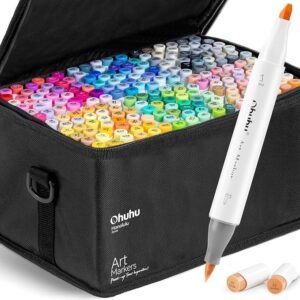
Ohuhu offers up to 320 colors (in their largest set), organized in a system modeled after Copic’s. It’s not identical, and some artists find the organization less intuitive. But 320 colors is genuinely impressive for a budget brand — you’ll rarely find yourself unable to match a color.
Color Matching
Can you find Ohuhu equivalents for Copic colors? In most cases, yes — or very close. The warm grays, cool grays, and skin tones are where you’ll find the closest matches. Unique or unusual colors (certain blue-violets, specific earth tones) may not have exact Ohuhu equivalents.
Winner: Copic for system elegance and color range. Tie for practical color availability.
Ergonomics and Build Quality
Barrel Design
The Copic Sketch has an oval barrel that’s comfortable and prevents rolling. The Ohuhu Honolulu has a round barrel with a slight contour. Both are comfortable for most hand sizes. The Copic feels more substantial — better plastic, tighter tolerances, more precise cap fit. The Ohuhu feels like what it is: a well-made budget product.
Cap Seals
Copic caps seal tightly and consistently. The ink stays fresh for years even in storage. Ohuhu caps are adequate but less precise — some users report markers drying out after 12–18 months in storage, even with caps firmly replaced. If you store markers for long periods between uses, Copic’s superior seal matters.
Weight and Balance
Copic Sketch markers are slightly heavier due to more ink and a denser barrel. Ohuhu markers are lighter. Neither causes hand fatigue in our experience, but artists with smaller hands may prefer the lighter Ohuhu.
Winner: Copic for build quality. Personal preference for comfort.
Real-World Testing: The Same Drawing, Two Brands
We drew the same subject — a portrait with skin tones, hair, clothing, and a simple background — once with Copic markers and once with Ohuhu markers, on identical Canson XL Marker paper. Canson paper review
Results
Skin tones: Copic’s E-series skin tones blended more smoothly, with more natural transitions between highlight and shadow. Ohuhu’s skin tones were slightly more streaky in the mid-tone transitions, though the final result was still good.
Hair: Both brands performed well. Hair involves layering and flicking techniques where minor blending differences matter less than stroke control.
Clothing (flat blue area): Copic laid down a flawless, even flat fill. Ohuhu showed slight overlap marks when filling a large area, requiring more careful technique to avoid streaking.
Background gradient (three-color blend): This is where the gap was most obvious. Copic’s three-color gradient was seamless. Ohuhu’s showed visible stepping between the three colors despite our best blending efforts.
Overall impression: At arm’s length — the distance most people view artwork — both drawings looked professional and competent. Up close, the Copic version had smoother transitions and more consistent fills.
Who Should Buy Copic?
- Professional illustrators whose income depends on consistent, portfolio-quality work
- Heavy users who go through markers frequently enough to benefit from refills
- Long-term artists who want to invest in a system they’ll use for decades
- Competitive or exhibition artists who need lightfast inks
- Manga and comic artists who need precise brush nibs for inking and coloring
Who Should Buy Ohuhu?
- Beginners who are learning alcohol marker techniques and don’t want to risk expensive tools
- Students on a tight budget
- Hobbyists who draw for pleasure and don’t need archival quality
- Artists who want a large color range immediately without spending thousands
- Mixed-media artists who use markers as just one of many tools and don’t need professional-grade performance from them
The Hybrid Approach
Many experienced artists use both brands. Here’s a practical strategy:
- Buy a large Ohuhu set (48 or 72 colors) for your base palette and practice
- Identify your 12–24 most-used colors after several months of drawing
- Buy those specific colors in Copic for professional work
- Use Ohuhu for sketching, practice, and experimental work — Save Copic for finished pieces
- Maintain your Copics with refills — Your per-use cost drops below Ohuhu over time
This hybrid approach gives you breadth (hundreds of colors) and depth (professional quality in your core palette) without breaking the bank.
Best alcohol markers buyer guide
Frequently Asked Questions
Are Ohuhu markers just cheap Copic knockoffs?
No. While Ohuhu clearly studied Copic’s color system and market positioning, their markers are original products with their own ink formulation, nib design, and manufacturing process. Calling them knockoffs is unfair — they’re a legitimate budget alternative that competes on value. Think of it like the relationship between a Toyota and a Mercedes: different price points, different quality levels, both legitimate products that serve different needs.
Can I use Ohuhu and Copic markers together in the same artwork?
Yes. Both use alcohol-based inks that are chemically compatible on paper. You can lay down Ohuhu color and blend Copic on top, or vice versa. The blending between brands won’t be quite as smooth as same-brand blending (the ink formulations differ slightly), but it’s absolutely workable. Many artists use Ohuhu for broad background areas and Copic for detailed foreground work.
Will Ohuhu markers ruin my Copic nibs if I use them together?
No. There’s no chemical incompatibility between the inks. Your Copic nibs won’t be damaged by contact with Ohuhu ink (or any other brand’s alcohol-based ink). The only thing you shouldn’t mix is ink inside the marker barrel — don’t try to refill a Copic with Ohuhu ink or vice versa.
How long do Ohuhu markers last compared to Copic?
In terms of ink capacity per fill, a Copic Sketch holds more ink and typically lasts longer before needing a refill — roughly 1,200 meters of line versus Ohuhu’s roughly 800 meters. But since you can’t refill Ohuhu markers, their absolute lifespan is limited to that single fill. A Copic marker, with refills and nib replacements, can last indefinitely. In terms of storage life (time before drying out even without use), Copic’s tighter cap seal gives it an advantage — stored Copics stay usable for years, while stored Ohuhu markers may dry out within 12–18 months.
If I can only buy one brand, which should I choose?
If you’re a beginner or hobbyist: Ohuhu. The value is incredible, the quality is genuinely good, and you won’t cry if you make mistakes or ruin a marker learning techniques. If you’re a serious or professional artist who draws frequently: Copic. The refill system, superior blending, and long-term durability make it the more economical and practical choice despite the higher upfront cost. If you’re somewhere in between, start with Ohuhu and graduate to Copic as your skills and commitment grow. How to use Copic markers guide